Home · Quiet rooms
A title, and a record book
The quietest rooms: Orfield’s phrase, and a Guinness average of -20.35 dBA
Orfield Laboratories still calls itself “The Quietest Place on Earth.” Guinness World Records, on 2 October 2015, gave a new title to a Microsoft chamber in Redmond. The figures on that page need care, including a missing minus sign left as written.
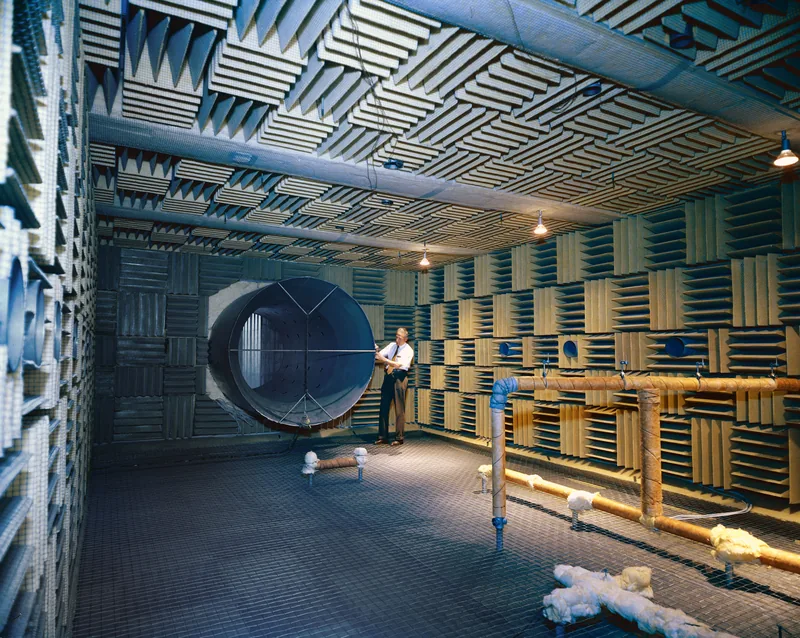
The photograph is not Orfield’s chamber, and it is not Microsoft’s. It is NASA’s aerodynamic noise facility in 1971, a public-domain picture of a room built to swallow sound, used here as a view of the idea of an anechoic chamber. Guinness, in 2015, defined such a room as “a room insulated from exterior sources of noise and designed to completely absorb reflections of sounds inside.” [source]
Orfield Laboratories, on the home page re-opened for this desk, describes the firm as “otherwise known as ‘The Quietest Place on Earth,’” “the world’s only independent, multi-sensory design research and consulting laboratory,” “offering testing services… since 1971.” That phrase is the laboratory’s own branding. It is quoted as branding, not as a current Guinness title. [source]
The 2015 Guinness figures, as written
Guinness World Records, on 2 October 2015, said Microsoft had “created the Quietest place on Earth at their headquarters in Redmond Washington, USA.” The report gives “an average background noise reading of an unimaginably quiet -20.35 dBA (decibels A-weighted).” “Two tests were carried out by professional independent sound specialists and the test results were 20.6 dBA and -20.1 dBA.” [source]
The missing minus on “20.6 dBA” is easy to “correct.” This desk does not. The sentence is quoted as Guinness printed it. The same page says those tests were “a considerably better figure than the creators’ hope for -16 dBA,” and that the new mark bettered “the record of -13 dBA which was recorded at the Anechoic Test Chamber at Orfield Laboratories, Minneapolis, Minnesota, USA in October 2012.” “The record first set in 2004 at only -9.4 dBA.” [source]
A Microsoft News Center video page dated 1 October 2015 is titled “What goes on inside the world’s quietest place? (Inside B87),” and asks whether “Microsoft’s anechoic chamber in the Audio Labs breaks the Guinness World Records title.” The video page is noted as a dated companion, not as a second set of official figures. [source]
So the shelf holds three things that should not be flattened into one: Orfield’s continuing self-description, the 2012 Guinness mark of -13 dBA at Orfield, and the 2015 Guinness average of -20.35 dBA at Microsoft, with test results written as “20.6 dBA and -20.1 dBA.” [source] [source]
The typographic sheet keeps those figures unblended, with no photographs inside. The quietest rooms (A4) · Letter.
Enjoyed this desk on icequakes, singing dunes, and rooms quieter than quiet?
No pop-ups. No intrusive advertising. Just interesting stuff. A little support helps the next ReallyByte site get built.