Home · Krakatoa
27 August 1883
The sound of Krakatoa, and the official distances that do not quite agree
A USGS volcano watch calls the 1883 explosions the loudest and farthest traveled sound in recorded history, heard nearly 5,000 km away. A NOAA page says the final explosion was heard across more than 10% of Earth’s surface, with reports more than 2,800 miles away. Both wordings stay on the desk.
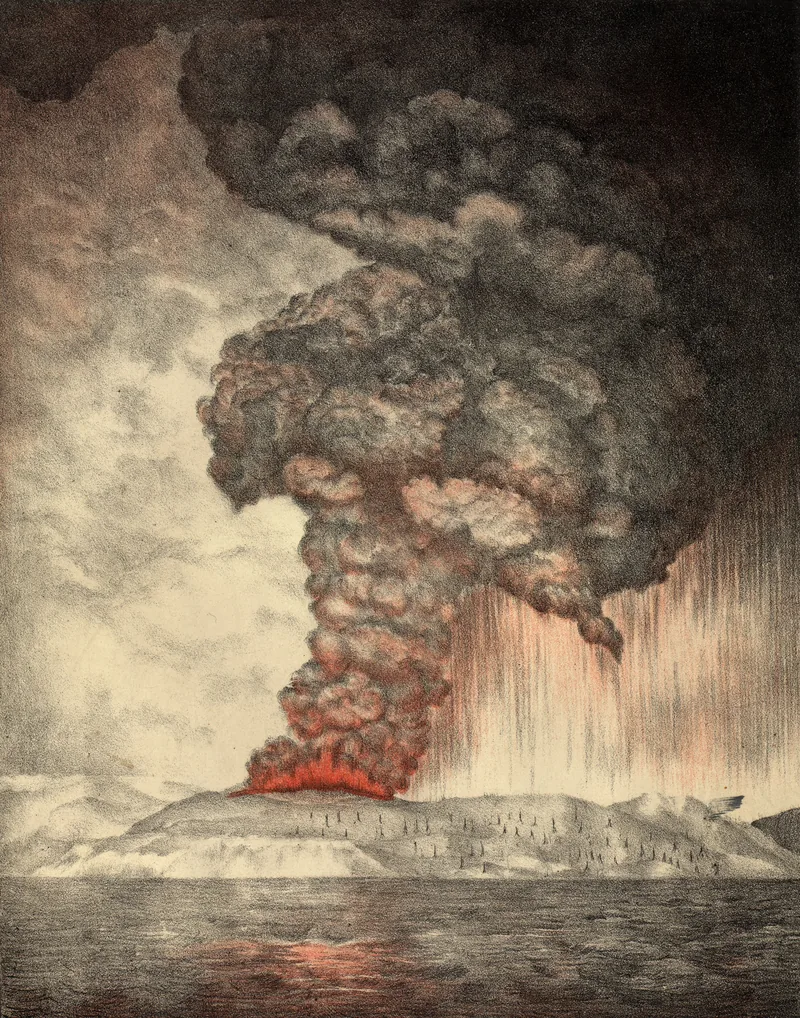
The lithograph on this page is from 1888. It is a period view of the eruption, not a photograph taken on the day, and it is here as a public-domain picture of how the event was drawn a few years later.
A USGS Hawaiian Volcano Observatory watch, dated 22 May 2003, opens the sound with a mistake that turned out to be geography. On 27 August 1883, it says, inhabitants of Rodriguez Island “heard the sound of heavy guns firing in the distance.” What they had heard were explosions from Krakatau, “which lay nearly 5,000 km (3,000 miles) to the northeast.” The Observatory calls that noise “the loudest and farthest traveled sound in recorded history.” [source]
The same watch is not only about the noise. “A total of 25 cubic kilometers (6 cubic miles) of material… were blown into the stratosphere, the eruption column reaching more than 30 kilometers (20 miles) high.” “A huge tsunami rushed from the exploding island and crashed against the nearby shorelines killing tens of thousands. At no time in history had more people been killed by a volcano.” Volcanic dust, the USGS says, “lingered for years, lowering global temperatures and creating livid sunsets.” [source]
A second official distance, left standing
NOAA’s National Centers for Environmental Information tell the same eruption with a different official reach. “The final explosion of Krakatau produced the loudest sound ever recorded in modern history, heard across more than 10% of Earth’s surface.” People in Australia and Mauritius, “more than 2,800 miles (4,600 kilometers) from the erupting volcano,” reported “what sounded like distant gunfire.” “Within a few hours, pressure waves traveled several times around the globe. Instruments measured the sudden spikes in Great Britain as well as in America.” [source]
Those two official distances — nearly 5,000 km / 3,000 miles on the USGS page, and more than 2,800 miles / 4,600 kilometres on the NCEI page — are not a disagreement this desk tries to settle. They are two agencies’ wordings, and they are not averaged, and they are not “corrected” into a single figure. NCEI also opens earlier in the year, with the captain of the German warship Elisabeth spotting “a cloud of ash and dust” on an early May morning in 1883. [source] [source]
An estimated 180 dB, and a gasometer in Batavia
In 1883, a Royal Society blog of 23 January 2024 reminds readers, the Council formed a special committee “to collect the various accounts of the volcanic eruption at Krakatoa, and attendant phenomena.” The same blog, looking back, says “the colossal third explosion of Krakatoa produced a pressure wave with an estimated sound intensity of 180dB, audible up to 5,000 kilometres away.” It “ruptured the eardrums of sailors aboard the RMS Norham Castle off Sumatra and caused a gasometer in the Batavia gasworks, 160 km away, to register a spike of over 8.5 kilopascals, surpassing the scale.” [source]
The 180 dB is an estimate, and is labelled that way here. This site does not replace it with a larger figure taken from a page that was not successfully re-opened for this rebuild. The 5,000 kilometres in the Royal Society sentence sits beside the USGS “nearly 5,000 km,” and still apart from NCEI’s 4,600 kilometres. [source] [source] [source]
The typographic sheet on this eruption keeps the distances unblended. The sound of Krakatoa (A4) · Letter.
Enjoyed this desk on icequakes, singing dunes, and rooms quieter than quiet?
No pop-ups. No intrusive advertising. Just interesting stuff. A little support helps the next ReallyByte site get built.