Home · Foley and radio
Footsteps, slaps, and a record library
Jack Foley’s footsteps, and the record libraries of old radio
For 33 years on Stage 10 at Universal Pictures, Jack Foley added footsteps, slaps and the rustle of clothes in time with the picture. In the golden age of radio, live studio effects were blended with discs from the mail-order libraries.
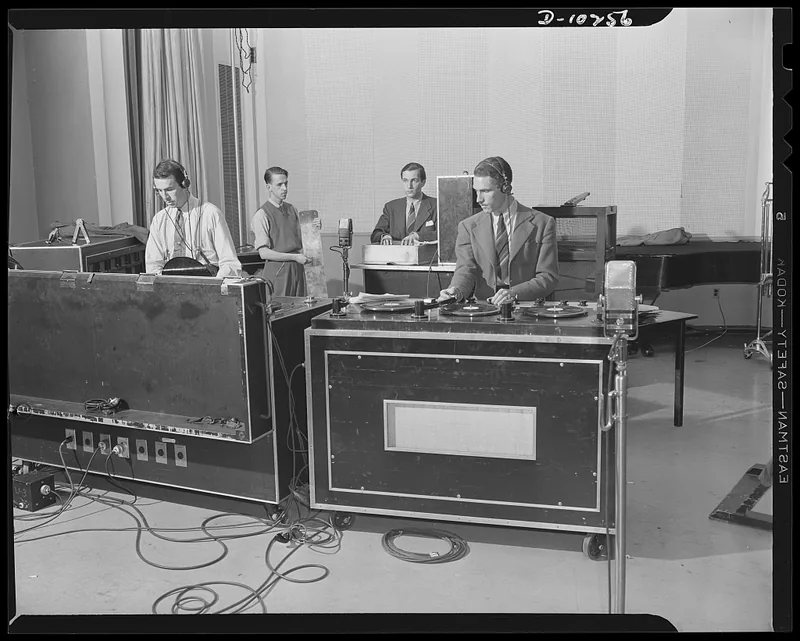
The photograph is a Library of Congress Farm Security Administration picture, taken in 1942 by David Bransby. It shows a sound-effects set-up for the War Production Board radio show “Steel,” “presented May 5 over the Blue Netwoerk.” The spelling is the Library’s, and it is left as written. It is a picture of radio work, not a portrait of Jack Foley. NPR, writing in 2005, said there was “no recording of Jack Foley’s voice; no picture of him on the sound stage.” He “passed away in 1967.” [source] [source]
What Foley left, NPR said, is heard “every time you hear a footstep, a slap, or the rustling of clothes.” “In his 33 years on Stage 10 at Universal Pictures, Foley perfected a method of projecting a film and adding all these sound effects in sync with the moving picture.” That is the official wording this desk uses for his working life: a named stage, a span of years, and a method. It does not add later legends about coconut shells or particular films that were not on the page re-opened here. [source]
The most powerful tool in the cupboard
Bill Corrigan’s Library of Congress blog of 20 March 2024 is about a slightly different cupboard: the recorded sound-effects library of American radio’s golden age in the 1930’s and 1940’s. Companies such as Gennett, Major Records, Speedy Q and Silver Masque sold recordings to stations by mail order. “The sound effects artists of the time blended these recording seamlessly with the effects that they performed themselves live in the studio.” The wording, including “these recording,” is the Library’s. [source]
Many people, Corrigan writes, “visualize those mechanical and acoustical tools of the Foley artist” when they imagine old-time radio. “The most powerful creative tool in sound effects was the record library.” The live coconut, the gravel tray and the slamming door still belong in the picture. So do the 78s and lacquer discs that could bring in a crowd, a train or a storm without anyone having to perform it in the room. [source]
The two stories meet without being forced into one biography. Foley’s name became the ordinary word for footsteps added to a film. Radio’s golden-age libraries were already doing a parallel job, live and on disc, in a different building. [source] [source]
Enjoyed this desk on icequakes, singing dunes, and rooms quieter than quiet?
No pop-ups. No intrusive advertising. Just interesting stuff. A little support helps the next ReallyByte site get built.